The Bluetooth Tesla coil market is weird
There are maybe... 50 different Bluetooth Tesla coil listings on Amazon right now. Most of them are the same 3-4 circuit boards in different acrylic enclosures, sold under names you've never heard of. The product photos look identical. The descriptions are copy-pasted. And the reviews are a mix of "AMAZING" and "it died after 20 minutes."
So I went through a bunch of them. Not a full lab test or anything, just sorting through what's actually out there, what the differences are, and what matters if you want one that plays music well.
What actually matters in a Bluetooth Tesla coil
Before the specific picks, here's what separates a good one from a bad one:
Arc length. Usually 5-15cm for desktop Bluetooth models. Longer arcs are louder and more dramatic, but they draw more power and generate more EMI. For a desk toy, 5-8cm is plenty. For showing off at a party... 10cm+.
Audio quality. This is the big variable. Some Bluetooth modules have terrible latency or clip the signal badly. The coil itself is monophonic (one note at a time), so you want a driver board that tracks the input frequency cleanly. There's no spec sheet for this, you kind of have to try it.
Build quality. Acrylic enclosures crack. Bare PCB designs collect dust and fingerprints. Look for something with decent standoffs and a top load (the metal disc or sphere on top) that isn't going to fall off.
Power supply. Most run on 12-24V DC. Some include a power supply, some don't. Check before you buy, because a random 12V adapter from your drawer might not supply enough current and the coil will sound weak or not arc at all.
The categories
Mini kits (under $30)
These are the entry-level ones you see everywhere. Typically a single PCB, 5-8cm arcs, powered by 12-15V. They use a basic Bluetooth module (usually a JDY-64A or similar) and a single MOSFET driver.
What to expect: Visible arcs, basic music playback, Bluetooth range of about 5-10 metres. Sound quality varies a lot between units, even identical-looking ones. These are fun for 15 minutes of "holy shit it's playing music through lightning" and then they become desk ornaments. Which is fine honestly.
What to watch for: The cheapest ones ($10-15) often skip the Bluetooth module and are audio-input only (3.5mm jack). That's not a dealbreaker, you can still play music through them, but you'll need a cable. Read the listing carefully.
Mid-range desktop coils ($30-80)
This is where it gets more interesting. Better driver boards, sometimes dual MOSFETs, better top loads, and occasionally actual enclosures instead of bare PCBs. Arc length is typically 8-15cm.
Some in this range come with both Bluetooth AND a 3.5mm input, which is ideal. Bluetooth for convenience, wired for when you want lower latency.
DRSSTC and SSTC kits ($100-500+)
Completely different league. These are proper Tesla coil kits with external interrupters, large arc lengths (30cm to 1m+), and serious power requirements. They don't have built-in Bluetooth typically, you connect via audio cable to the interrupter.
If you're reading a "best Bluetooth Tesla coils" article, these probably aren't what you're looking for right now. But they're what you graduate to if you get hooked. Eastern Voltage Research's Plasmasonic series and Loneoceans' designs are well-regarded in the community.
Getting music playing
OK so you bought one. It showed up. Now what?
The biggest mistake people make is pairing it via Bluetooth and immediately playing Spotify. That won't work well. Tesla coils need simple, clean audio signals - one note at a time, square-ish waves. A full band mix just sounds like angry buzzing (or nothing at all, because the driver can't track the complex waveform).
What you want is software that generates the right kind of signal. Monophonic, clean frequency content, designed for how Tesla coils actually work.
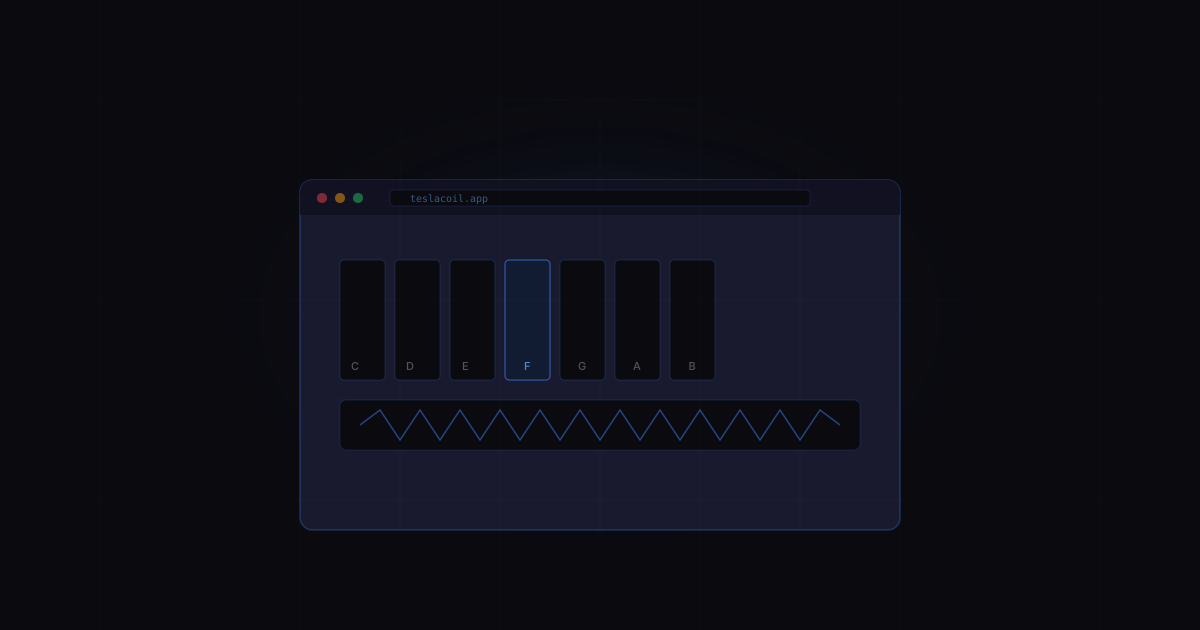
Tesla Coil Audio Driver does exactly this. It's a free browser app, works on your phone, no install needed. Open it, pair your coil, pick a sound from the library or play the keyboard. The app generates audio signals that Tesla coils can actually reproduce as clean musical notes.
There's a full setup guide for Bluetooth Tesla coils if you want the step-by-step, and a compatibility page that covers what types of hardware work with the app.
Quick tips from experience
- Don't run it continuously for more than 10-15 minutes. These things get hot. The driver MOSFETs especially. Let it cool between sessions.
- Bluetooth module names are random. Your coil might show up as "BT-Tesla," "JDY-64A," "BT-Audio," or just "Tesla Coil." Sometimes it's literally "BK8000" which is the chip name. Don't panic, just pair whatever new device appeared.
- The power supply matters more than you think. A 2A supply on a coil that wants 3A means weak arcs and bad audio tracking. If your coil sounds weak, try a higher-current power supply before assuming the coil is broken.
- EMI is real. A Tesla coil 30cm from your laptop can interfere with Bluetooth, Wi-Fi, and USB devices. Give it some distance. If your Bluetooth keeps dropping, move your phone further from the coil (counterintuitive but it works).
- Phone speakers work for testing. You don't need the coil powered on to check if the app is generating the right signal. Play it through your phone speaker first, get the sound you want, then send it to the coil.
The honest take
Most Bluetooth Tesla coils in the $20-50 range are genuinely fun. They're not high-fidelity instruments and the build quality is hit-or-miss, but watching lightning play a melody on your desk never really gets old. The technology is sound even if the packaging is sometimes questionable.
If you get one and the music part disappoints you, it's almost certainly a software problem, not a hardware problem. The right audio signal makes a massive difference. That's the whole reason the app exists.