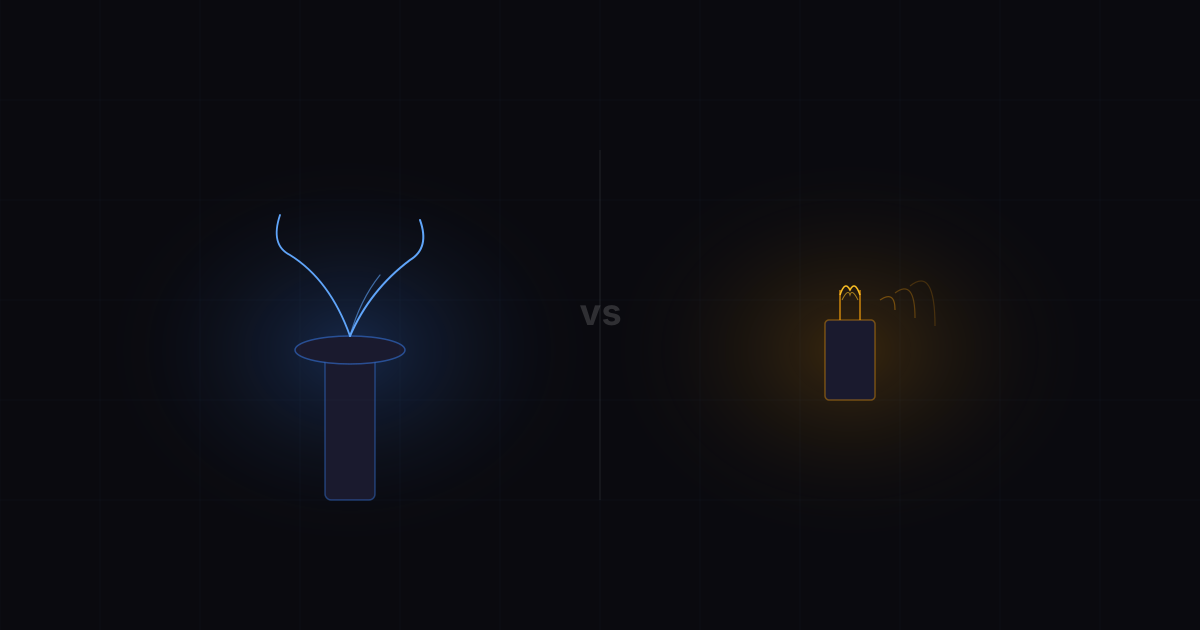
They both use arcs. That's about where the similarity ends.
If you've been looking into "singing Tesla coils" or "plasma speakers" you've probably seen the terms mixed up. I own a musical Tesla coil and I've messed around with plasma speaker circuits, and they're really different things despite both making sound from electricity.
Musical Tesla coils
A Tesla coil is a resonant transformer. It takes low voltage and steps it up to tens or hundreds of thousands of volts, enough to ionise the air and create visible arcs.
In a musical coil, an interrupter switches the coil on and off at audio frequencies. Each burst of arcs creates a pressure wave. Control the burst rate, control the pitch. Simple as that.
The numbers:
- Voltage: 50,000V to 500,000V+ depending on size
- Arc length: anywhere from 5cm on a desktop coil to 3m+ on the big ones
- Frequency range: roughly 20Hz to 2,000Hz for music (sweet spot is 100-2,500Hz)
- Volume: loud. Really loud. Big coils are comparable to a PA system
- Sound character: raw, buzzy, square-wave. Sounds like an NES
Plasma speakers
A plasma speaker (sometimes called an ionic speaker) is a completely different beast. It creates a small, stable plasma arc between two electrodes and modulates it directly with an audio signal. The arc expands and contracts at audio frequencies.
The numbers:
- Voltage: 5,000V to 30,000V typically
- Arc size: a few millimetres, continuous and stable
- Frequency range: roughly 500Hz up to 40,000Hz. They're excellent at high frequencies
- Volume: quiet to moderate
- Sound character: clean, detailed. More like a high-end tweeter
Side by side
| Musical Tesla Coil | Plasma Speaker | |
|---|---|---|
| What it's for | Visual spectacle + sound | Audio reproduction |
| Arc size | Centimetres to metres | Millimetres |
| Sound | Raw, buzzy, one note at a time | Clean, wide bandwidth |
| Bass | Good, can go low | Weak. Small arc can't move enough air |
| Treble | Limited, but harmonics fill in | Excellent, extends into ultrasonic |
| Volume | Very loud | Quiet |
| Safety | High. Lethal voltages possible | Moderate. Still high voltage, don't be stupid |
| Size | Desktop to room-sized | Palm to desktop |
| Cost | £30 to £5,000+ | £20 to £500 |
How they actually sound
Plasma speakers are the audiophile option. The arc has almost no mass compared to a speaker cone, so it can respond to high frequencies really well. Audiophile plasma tweeters are a real thing. But they're weak at bass because the tiny arc just can't push enough air. Most plasma speaker builds end up paired with a conventional woofer.
Musical Tesla coils are the opposite. Good at fundamentals, terrible at fidelity. The sound comes from on/off switching rather than smooth modulation so everything has that buzzy, harmonic-rich tone. More synthesiser than speaker. That's not a bad thing though... it sounds incredible for the right music.
Which one to get
If you want something dramatic that plays recognisable melodies through visible lightning and you don't mind the safety considerations... get a Tesla coil.
If you want genuinely good audio quality for treble and mids, a compact desktop project, and something you can experiment with at lower (but still dangerous) voltages... plasma speaker.
I'm biased. I built a whole app for Tesla coils. But I get the appeal of plasma speakers too.
Using teslacoil.app with your coil
If you've got a musical Tesla coil, teslacoil.app gives you the tools to drive it from your phone or laptop. Over 150 tracks in the sound library, a sequencer for making your own, and a calibration tool for Bluetooth latency. Connect via Bluetooth or 3.5mm cable and you're set.