The problem with Tesla coil music right now
Most people who buy a musical Tesla coil do the same thing. They pair it over Bluetooth, stream some Spotify, and... it sounds terrible. The coil buzzes and crackles and nothing is recognisable. So they try our sound library and that works better, because those tracks were made for coils. But they're still just pressing play on someone else's music.
What if you want to make your own?
The existing answer is: learn MIDI, get a DAW, figure out which channel works, export, convert, test. If you're already a musician with a studio setup that's fine. For everyone else it's a wall. And most people who buy a Bluetooth Tesla coil off Amazon aren't producers. They're curious people who thought lightning playing music was cool.
Why the 303
The Roland TB-303 is kind of the perfect metaphor for what we're trying to do. It was designed in 1981 as a bass accompaniment for solo musicians. It flopped. Nobody wanted it. Then a few years later people in Chicago started buying them for cheap and using them wrong... cranking the filter, the resonance, making these wild squelchy sounds that became acid house.
The 303 turned non-musicians into musicians. You didn't need to know theory. You put notes on a grid, twisted some knobs, and something good came out. That's exactly what a Tesla coil instrument should be.
So we built one.
It's not actually a 303
I should be clear about this. A real TB-303 has a resonant low-pass filter that's responsible for most of the acid sound. We can't do that. A Tesla coil reproduces frequency, not filtered audio. It fires or it doesn't. There's no filter sweep happening in a lightning arc.
What we can do is a frequency sweep. Our version of "squelch" starts each note above the target pitch and sweeps down. The coil reproduces this as an audible chirp in the arc. It's not the same as a 303 filter, but it gives you that sense of movement and attack that makes acid music feel alive. And it works through lightning, which the original 303 definitely cannot do.
Your phone is the instrument
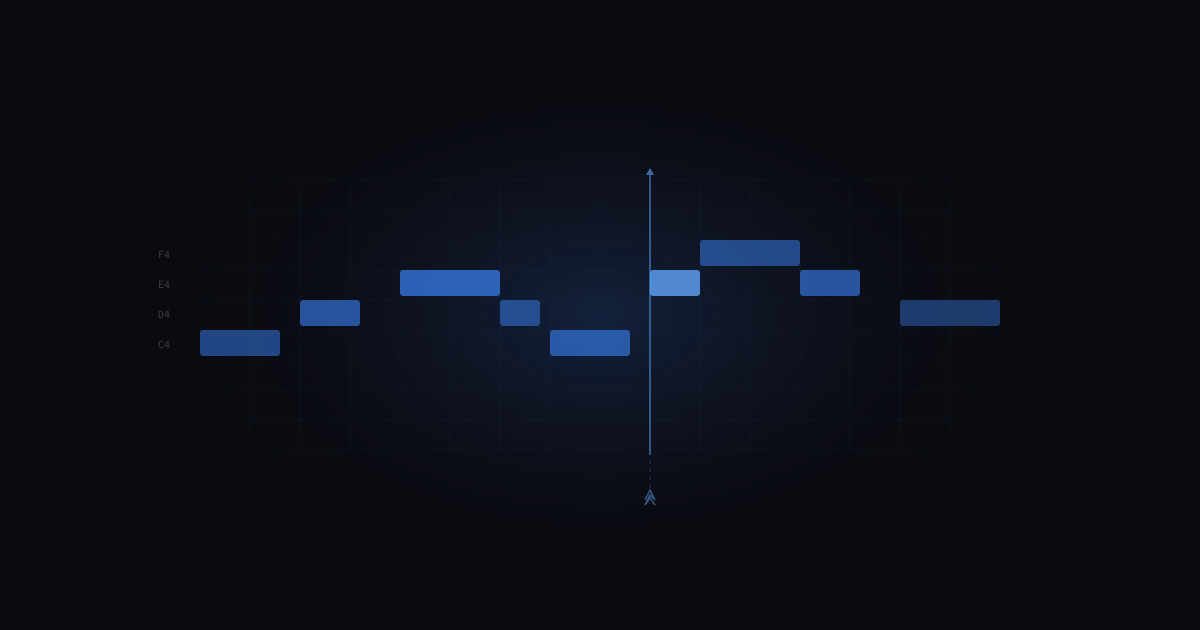
Here's the bit that matters. You open teslacoil.app/303 on your phone. You tap steps on a grid. You pick notes on a little keyboard. You hit play. That's it, you're making acid music.
No DAW. No MIDI cables. No firmware. No studio monitors. Your phone, a Bluetooth Tesla coil, and your fingers.
You want it thicker? Turn up the grit knob (adds a detuned sub-octave). Want notes to bleed into each other? Toggle slide. Want that acid chirp? Crank squelch. There are presets if you just want to hear what it can do before programming your own stuff.
Your patterns save automatically. Come back tomorrow and they're still there.
Why this matters
The mission of teslacoil.app is to put Tesla coils in everyone's hands. That means removing barriers. The sound library removed the "what do I play" barrier. The keyboard removed the "how do I play a note" barrier. The 303 removes the "how do I make my own music" barrier.
A kid with a Bluetooth Tesla coil and a phone can now program acid basslines and play them through lightning. No gatekeeping behind expensive gear or technical knowledge. That's the point.
Try it
teslacoil.app/303. Sign in, load a preset, hit play. If you have a coil, connect it and watch the arcs dance to patterns you made yourself.